STOP CONFORMING. START TRANSFORMING.

FREE PREVIEW
Chapter One:
The Problem Isn’t You
The right faith. The wrong fight.
Press play to listen while you read
The room grows quiet as the worship team begins to play. Conversations soften, people turn toward the front, and the first notes settle over the sanctuary. You close your eyes, lift your hands, and join the voices around you.
The song is familiar, but this morning it feels personal. You are not merely repeating lyrics on a screen; you are saying something you want to be true in every area of your life. For these few moments, the things that have been weighing on you feel less overwhelming, and the pressure inside begins to ease.
You sing about His faithfulness, and memories rise to support the words. You remember prayers He answered, doors He opened, and seasons He carried you through when you could not imagine how life would ever feel normal again. The problems waiting beyond the church doors have not disappeared, but they no longer seem larger than the God you are worshiping. The future feels less threatening, the past loosens its grip, and hope quietly returns to the places worry has occupied all week.
The pastor opens God’s Word, and the message seems to meet you exactly where you are. You underline a verse and jot a few words beside it because you do not want to forget what you are hearing. More than once, the same thought crosses your mind: This is exactly what I needed.
What is happening in you is real. You are not performing for the people around you or borrowing emotion from the room. Your worship is sincere, and so is your desire to trust Him. When you pray during the final song and place the week ahead in His hands, you mean every word.
The drive home feels lighter than the drive to church. The responsibilities waiting for you have not changed, but they no longer feel as controlling. You decide to pray before assuming the worst and remember what God has already done. Before bed, you reread the verse you underlined and thank Him for reminding you that you are not facing the week alone.
Sunday was real.
Later that week, the alarm sounds before the room is fully bright. Before your feet touch the floor, your mind is already moving through the day ahead: the conversation you need to have, the bills that need to be paid, and an upcoming appointment. For another moment, you do not move, but your mind does, replaying what you said yesterday and imagining how everything might unfold.
Then you reach for your phone. An unanswered message feels personal, a headline gives you another reason to fear the future, and someone else’s photograph quietly reminds you of the life you believe you should have built by now. Nothing has happened, yet your body is already responding as though it has. Your chest tightens, you notice that you are clenching your teeth, and the peace that felt so natural during worship is suddenly difficult to find.
Within minutes, you have absorbed more fear, urgency, and comparison than you realize. You have not opened your Bible or spoken to another person, but your mind has already delivered a sermon of its own, reminding you of your failures before it remembers God’s grace and warning you not to expect too much or become too hopeful.
In the kitchen, you begin preparing coffee and whisper, “Lord, help me today.” You mean it, but the conversation beneath the prayer continues, replaying yesterday and preparing for problems that may never come. By breakfast, your body is in the room while your mind is everywhere else, occupied with possibilities it has already begun treating as facts.
You know what Jesus said about tomorrow. You believe those words. You may have underlined them, memorized them, and shared them with someone who needed encouragement. Yet when tomorrow becomes your tomorrow, worry often sounds more believable than trust.
The thoughts arrive so naturally that you rarely recognize them as thoughts. You love God, believe His Word, and genuinely desire to obey Him and become more like Christ. Your faith on Sunday was sincere, yet only days later, thoughts and reactions you believed you had surrendered return with familiar authority.
That tension is difficult to admit because it feels like a contradiction. If you truly trust God, why does fear still control so many of your responses? If you believe you are forgiven, why does shame still know exactly how to find you? If your identity is in Christ, why can one person’s disappointment make you question your worth?
Perhaps you have heard the answers before. You may even know the verses that speak to these struggles, and on many days, you genuinely believe what they say. Yet knowing what is true does not always mean we live like it is true. You can sing about freedom while responding like someone trapped, speak about grace while punishing yourself for every mistake, and believe God loves you while still living as though His affection must be earned.
This does not mean your worship was empty or your faith is counterfeit. It means you can genuinely believe the truth while still carrying patterns of thought that have not learned to agree with it.
Somewhere between what you sincerely believe and how you instinctively respond, there is a gap. Over time, that gap becomes personal. You stop asking why the pattern keeps returning and begin wondering what its return says about you. Perhaps you are not disciplined enough, do not pray enough, or simply lack the faith other people seem to have.
After another anxious night or familiar reaction, the same question rises: What is wrong with me?
The question feels reasonable because you have tried to change. You have prayed, read, listened, promised, repented, and begun again. Yet something familiar keeps returning, and each return seems to provide more evidence that something is fundamentally wrong with you.
But what if that conclusion is the first thing we need to question?
The Conversation You Never Chose
Most of the thoughts that shape our days do not feel chosen. They arrive already formed, carrying our vocabulary, our memories, and the familiar sound of our own inner voice. They feel more like observations than interpretations, so we rarely stop to question them. They simply speak, and because the voice sounds like our own, we listen.
Notice how quickly your mind can reach a conclusion before you have examined what is actually happening. Someone looks distracted during a conversation, and you wonder whether you said something wrong. A friend does not respond to a message, and the silence begins to feel like rejection. Your spouse answers with fewer words than usual, and you start preparing for a conflict that may not exist.
The conclusion arrives so quickly that you barely recognize it as an interpretation. It feels less like a story you are telling yourself and more like the truth of the situation. Yet the conclusion often feels certain before you have enough evidence to support it.
The distracted person may be tired, the message may have gone unnoticed, and your spouse may be preoccupied with something unrelated to you. Many explanations are possible, yet the mind often settles on one before the evidence arrives. It tends to choose the meaning that feels most familiar.
This is why the same event can affect two people so differently. A delayed response may barely register for one person and feel deeply threatening to another. A mistake may become useful feedback for one person and proof of failure for someone else. The event matters, but the meaning assigned to it often matters more.
We often notice the emotion without noticing the thought that came first. By the time anxiety, anger, embarrassment, or shame becomes obvious, the mind has already interpreted the moment so quickly that it feels as though the situation itself created the reaction.
Someone overlooks your contribution, and resentment rises. Another person disagrees with you, and defensiveness appears. A plan becomes uncertain, and fear begins arranging the future. The emotion feels immediate, but somewhere between the event and your reaction, your mind has already decided what the event means.
This pattern follows a sequence we will return to throughout this book: an event is interpreted, the interpretation produces an emotional response, and that response influences what we do next. We will call this The Hidden Sequence because most of it occurs before we recognize what is happening.
THE HIDDEN SEQUENCE
Event
↓
Interpretation
↓
Emotion
↓
Reaction
↓
Consequence
Because the conclusion forms so quickly, the inner conversation rarely draws attention to itself. It sounds like ordinary thought, using phrases so familiar that they no longer seem to require proof. It may tell you that you always mess things up, that people eventually leave, or that everything will fall apart if you do not stay in control. Because the voice sounds like your own, you rarely stop to examine what it is saying.
These thoughts do not always arrive as complete sentences. Sometimes they register as tension in your body, an urge to withdraw, or an immediate need to explain yourself. The thought may disappear almost as soon as it produces a reaction, leaving only the feeling behind. You may never hear the words clearly, but you still live from their meaning.
Over time, these conclusions begin functioning like an unseen narrator. They explain other people’s motives, predict how situations will end, and tell you when to speak, withdraw, trust, or protect yourself. The narrator rarely considers another explanation. It speaks with the confidence of a story repeated so often that it no longer feels like a story. Familiarity can easily be mistaken for truth.
This does not mean every spontaneous thought is false or every emotion should be distrusted. Our minds can recognize real danger, remember wisdom, and draw sound conclusions. The problem is not that thoughts arise automatically, but that we often agree with them automatically.
We rarely stop to ask what we are agreeing with. Instead, we move from thought to feeling, from feeling to reaction, and from reaction to consequence. Then we focus on the visible result: the words we regret, the opportunity we avoided, the relationship we strained, or the night we lost to worry. We promise to respond differently next time without examining the thought that made the reaction seem necessary.
This is why some reactions seem to move faster than our intentions. By the time we remember how we wanted to respond, an interpretation has already shaped the moment. What appears sudden may have been set in motion by a thought we barely noticed.
Because the conversation has become ordinary, it follows you into relationships, decisions, prayer, work, and rest. It shapes how you interpret another person’s expression, imagine the future, and decide what a mistake says about you. Most of the time, you do not hear it as a conversation at all. You hear it as yourself.
When Familiar Feels True
A familiar thought has an advantage over a new truth: it has history. Over time, it can feel more believable than something you are still learning to trust. Each repetition makes the pathway easier to follow until the response begins to feel automatic. By the time another explanation appears, the familiar thought often feels like the obvious one.
This is why unhealthy patterns can feel so reasonable. Fear may present itself as preparation, control as responsibility, and people-pleasing as love. Replaying a conversation can seem necessary, while expecting disappointment may feel safer than hope. The pattern rarely identifies itself honestly.
Fear does not admit that it is filling your mind with possibilities you cannot control; it tells you to be careful. Control does not reveal its fear of uncertainty; it tells you responsible people stay prepared. People-pleasing does not confess how threatening rejection feels; it tells you good Christians put others first.
Each pattern borrows something from the truth. Wisdom does prepare, love considers others, and humility recognizes our limits. That is what makes unhealthy beliefs difficult to recognize: fear can be called discernment, avoidance can be called peacekeeping, and overwork can be called dependability. Respectable labels make painful patterns easier to defend.
The present can awaken an old conclusion without revealing that it has done so. A delayed response, a change in plans, or a disappointed expression may touch a belief that was already there.
A woman sends her adult daughter a message and receives a brief reply several hours later. Nothing in the response is openly unkind, but something in its tone feels different. She reads it again, then scrolls upward through the conversation looking for what she might have said wrong. By the time she puts down the phone, the message is no longer merely brief. In her mind, it has become evidence that distance is growing between them.
She considers asking whether everything is okay, but decides that might make things worse. Instead, she becomes unusually quiet, rehearses what she will say if her daughter calls, and carries the tension into the rest of her evening. The response may have meant nothing more than that her daughter was busy, but the familiar belief arrived before any explanation did: When someone becomes distant, it is probably because of me.
An ordinary moment has become evidence for a belief that was already in place. Evidence that challenges the belief is easier to dismiss. A faithful friend becomes an exception, success is credited to luck, and the many ways God has carried you can feel less convincing than the one prayer that remains unanswered. The familiar belief survives because it has learned how to explain everything.
This does not mean we are intentionally resisting truth. Repetition simply gives the familiar interpretation a head start. This helps explain why a verse can feel deeply meaningful during prayer and strangely distant under pressure. The truth has not changed; the older thought has simply practiced arriving first.
A belief does not have to be consciously chosen to shape us. It only has to become familiar enough that it stops feeling like a belief. Eventually, we experience it as personality, common sense, or reality.
We begin saying, I have always been anxious. I need to stay in control. I cannot trust people. The language shifts quietly from what we experience to who we believe we are. A repeated response becomes a personal description, and a learned defense begins to sound like an identity. What the mind has practiced begins to feel inseparable from who we are.
This is why familiar patterns can be so difficult to challenge. If worry has made us feel responsible, peace can seem careless. If control has helped us feel safe, surrender can feel dangerous. If performance has earned approval, grace can feel undeserved.
Even freedom can feel threatening when bondage is familiar. The Israelites had left Egypt, yet under pressure the familiarity of captivity sometimes seemed safer than dependence on God in the wilderness. We may wonder how they could long for what once enslaved them, then return to our own familiar patterns for much the same reason: we know what to expect from them.
Renewal begins by questioning thoughts that have felt reasonable, protective, and deeply personal. Some may still feel as though they are protecting us, even while preventing us from living fully in the present. Not every familiar thought is false, but familiarity is not proof. A thought can be old and still be wrong, a conclusion can feel personal and still be learned, and a reaction can feel natural only because it has been practiced.
What feels most like you may simply be what has become most familiar.
Somewhere You Learned This
No one is born believing they are difficult to love. A child does not enter the world assuming that mistakes make them worthless, conflict leads to abandonment, or peace depends on keeping everyone happy. Those conclusions are learned, often before we are old enough to understand what is happening around us.
A child who learns that anger can erupt without warning becomes alert to changes in tone, expression, and mood. That awareness may help her navigate the home in which she is growing up. Years later, she can walk into a quiet room and immediately assume someone is upset. The environment has changed, but the conclusion still arrives on time.
She may describe herself as intuitive, and perhaps she is. She may also be interpreting ordinary silence through an old expectation of danger.
Another child receives attention mainly when he succeeds and begins associating achievement with approval and belonging. As an adult, he may become disciplined, productive, and admired, yet rest makes him uneasy and failure feels deeply personal. What looks like ambition may also be an old attempt to prove that he still deserves his place.
Children notice far more than they understand. They can sense disappointment, tension, or distance without knowing what caused it, and when information is missing, the mind supplies an explanation. A child may decide that affection depends on achievement, that safety requires constant vigilance, or that another person’s unhappiness must somehow be their fault. These conclusions are not foolish; they are attempts to make an unpredictable world understandable.
We rarely choose these conclusions deliberately. They form through experience, often as ways of reducing pain, avoiding conflict, or creating a sense of safety. What begins as a response to one season can eventually become a way of seeing every season.
The same process continues long after childhood. Betrayal can teach caution, humiliation can make visibility feel dangerous, and a painful church experience can distort how someone hears correction or even the voice of God. The season may end, but the lesson can remain. One rejection may become the expectation that people will always leave, and one failure may become a reason to stop taking risks altogether.
Over time, the mind stops connecting the present reaction to the experience that first shaped it. You may no longer remember when you began preparing for rejection or why disagreement feels so threatening; the pattern simply feels like part of your personality. You say, I have always been this way. But it may be more accurate to say, I have practiced responding this way for a very long time. Calling it personality makes it sound permanent. Recognizing it as learned reveals that it has a history.
A woman may describe herself as a peacemaker because she has spent years preventing conflict. She anticipates what others need, softens every disagreement, and apologizes before deciding whether she has done anything wrong. Her kindness may be genuine, but fear may also be directing it. Somewhere along the way, she learned that another person’s displeasure was dangerous and that maintaining peace was her responsibility.
These patterns are difficult to question because they were not always entirely destructive. Reading a room may have helped someone navigate a volatile home, achievement may have opened doors, and control may have created order during chaos. The mind remembers what once worked, even after the circumstances have changed. A response that began as protection can eventually become a prison.
That protection can outlive the danger. The child who learned not to speak may become an adult who struggles to advocate for herself. The teenager who expected nothing in order to soften disappointment may later struggle to receive joy without suspicion, while the person who became independent because no one was dependable may find intimacy uncomfortable even with trustworthy people. The pattern continues because the mind still believes it is providing safety.
This is why change can feel threatening even when the pattern itself is painful. Letting go of people-pleasing may feel selfish, releasing control may feel irresponsible, and trusting others may feel reckless. The old response remains difficult to release because some part of the mind still believes it is keeping you safe.
Yet the situation in front of you may no longer be the one that taught you how to respond. The person offering correction may not be the parent whose disappointment once felt unbearable, and the spouse asking an honest question may not be the person who used vulnerability against you. The present can resemble the past without being the past.
Even so, the mind may react to resemblance before recognizing the difference. A tone of voice, a facial expression, or a sudden change of plans can awaken an old conclusion before you understand what is happening. What feels like a reaction to today may also be a response shaped by something much older.
Recognizing the history behind a response does not excuse the harm it may cause. Our reactions still affect other people, and pain does not make every choice acceptable. But responsibility becomes more useful when joined by understanding. Condemnation says the struggle proves something is wrong with you; understanding asks what taught your mind to respond this way, opening a door that shame keeps closed.
If a pattern has a history, it does not have to become a destiny. A belief formed through experience can be examined in the light of truth, and a learned response can be practiced differently. But first, we must begin separating who we are from what our minds learned to do.
What once felt necessary may now feel inseparable from who we are. But familiar is not the same as permanent.
The Wrong Battle
By the time the house is quiet, the tension from the day has followed you into the evening. A conversation keeps replaying, and each time you revisit it, you hear something new in the other person’s tone. You reach for your phone intending to check one thing, but soon you are scrolling without paying attention to what is passing in front of you. For a while, the noise inside grows quieter.
Nearly an hour passes before you put the phone down. The conversation has not changed, and nothing has been resolved, but now the frustration is directed at yourself. You promised you would stop losing so much time this way, and you tell yourself that tomorrow you will be more disciplined. Yet when discomfort rises again, the same habit is waiting.
For someone else, the habit may involve food, shopping, work, or another form of escape. The behavior changes, but the reason for reaching for it is often the same: This will help me feel better for a little while. The relief may be real, but it is temporary, and the feeling that sent you searching for relief remains untouched.
Repeated or compulsive behaviors do not always have a single cause. Trauma, physical dependence, established habit loops, and other factors may also be involved and may require wise professional support. Even so, many behaviors that create problems are also attempting to solve one by offering comfort, distraction, control, or escape from something that feels difficult to face directly.
Because the behavior offers relief so quickly, you may not recognize the pattern until after the moment has passed. The words have been spoken, the purchase has been made, the food has been eaten, or the hour has disappeared. Only then do you recognize how quickly the reaction took over and how little time there seemed to be between the discomfort and the response.
You know how you wanted to handle the moment. You may have prayed about it, reminded yourself of what was true, and prepared to respond differently. Afterward, you apologize where necessary, ask God to forgive you, and make a familiar resolution: next time, you will catch the pattern sooner. For a moment, that resolution feels hopeful because it gives you a simple plan: be more careful and try harder.
For a while, determination may work. You become more careful, avoid certain situations, and watch for the first sign of the old pattern. Then a moment catches you tired, embarrassed, disappointed, or afraid, and the response returns with unsettling ease. What requires enormous effort to resist seems to require almost no effort to repeat.
The same dynamic appears in relationships. A woman agrees to another request even though she is already exhausted. She knows she needs better boundaries and may be able to explain them clearly to someone else, but when the moment comes, saying no feels heavier than saying yes.
The real cost is not simply the discomfort of declining. Somewhere beneath her immediate agreement is the belief that another person’s disappointment would make her selfish, unkind, or difficult to love. As long as that belief remains untouched, saying no will feel like more than setting a limit. It will feel like risking belonging.
A man may become defensive whenever someone questions a decision he has made. He tells himself to listen without interrupting, but his voice changes before he has fully considered what the other person is saying. If being wrong feels like being exposed as incompetent, defending himself will seem less like a bad habit and more like self-protection.
The woman is not only struggling to say no, and the man is not only struggling to receive correction. The person scrolling late into the evening may be dealing with more than a lack of discipline. Each is trying to restrain a visible behavior while an unseen belief continues pressing beneath it.
That is why change can feel like holding a door closed while someone keeps pushing from the other side. As long as our strength remains, the door stays shut. When we become tired, distracted, or overwhelmed, it begins opening again.
We often respond by applying more pressure. We make stricter rules, stronger promises, and more detailed plans. Those practices may help, and obedience still requires intentional choices, but effort aimed only at the visible behavior cannot reach the belief that keeps making the behavior feel necessary.
A gardener does not restore a sick tree simply by removing damaged fruit from its branches. The fruit matters because it reveals what the tree has been drawing from beneath the surface. Removing it may improve the appearance for a season, but another season will reveal whether anything changed at the root.
Our reactions can serve the same purpose. Anger may reveal a fear of being powerless. Worry may expose the belief that constant vigilance is the only thing protecting the people we love. People-pleasing may reveal that approval has become connected to worth, while a compulsive habit may reveal how difficult it has become to remain present with discomfort.
The reaction is not always the deepest problem. Sometimes it is evidence pointing toward it.
This does not make harmful behavior unimportant. Apologies still need to be made, habits may need firm boundaries, and obedience requires action. Understanding the root is not an excuse for the fruit. It is an attempt to stop cutting off the same fruit every season while leaving the root untouched.
Jesus repeatedly moved beneath outward behavior to address what was taking place within the heart. He did not treat actions as meaningless, but neither did He pretend they appeared from nowhere. What we repeatedly do often reveals what we have come to believe about safety, worth, love, control, pain, and God.
You may have spent years trying to become more patient without asking why certain moments feel so threatening. You may have tried to stop reaching for relief without examining what feeling you are trying to escape. You may have prayed for freedom from comparison while leaving unquestioned what another person’s success seems to say about you.
The effort was real, and so was the desire to change. The return of the pattern does not necessarily mean you were unwilling to fight. It may mean that the battle you could see was only the evidence of another battle taking place beneath it.
That possibility changes the meaning of the struggle. What looked like a failure of effort may have been effort applied at the wrong level. The place requiring renewal may be deeper than the place where you have been applying pressure.
You may not need to fight harder. You may need to discover what you have actually been fighting.
Who Told You That?
In the opening chapters of Genesis, shame enters the human story almost immediately after deception. Adam and Eve do not simply break a command and continue as before. Their perception changes. They become aware of themselves in a new way, feel exposed, and hide from the God whose presence had once been their place of safety.
When God finds Adam among the trees, He asks a question that reaches beneath the hiding place: “Who told you that you were naked?” God is not asking because He lacks information. He is drawing Adam’s attention to the source of a conclusion he had never held before.
Adam had been naked before. The condition was not new. What changed was the meaning attached to it. Innocence became exposure, openness became danger, and the presence of God became something to avoid rather than enjoy.
The question was not merely about clothing. It was about interpretation.
The serpent had distorted what God said, questioned His motives, and suggested that something good was being withheld. Once Adam and Eve acted on that deception, they no longer saw God, themselves, or one another in the same way. They covered themselves, withdrew from one another, and hid from God.
Deception changed perception, and perception changed behavior.
The same movement can still take place within us. A false belief changes the meaning we assign to an experience, then begins directing how we respond. By the time the behavior becomes visible, the interpretation beneath it may already feel unquestionable.
This is why we often begin with the wrong question. We ask why we worry, why we become defensive, why approval matters so much, or why one mistake can leave us feeling condemned for days. Those questions matter, but they usually begin with the reaction. God’s question moves closer to the source.
Who told you that one failure made you a failure? Who told you that another person’s disappointment reduced your value? Who told you that love must be earned through usefulness, silence, achievement, or sacrifice? Who told you that correction meant rejection, or that God’s silence meant He had forgotten you?
Sometimes the source is easy to remember. Someone called you careless, weak, difficult, selfish, or incapable. A teacher treated you as though you lacked ability, a friend used your vulnerability against you, or someone you trusted repeatedly made affection feel conditional. The words may have been spoken only once, but the conclusion survived because it seemed to explain something painful.
At other times, no one stated the belief directly. You learned it through repetition, betrayal, loss, disappointment, or the messages surrounding you. Praise appeared when you succeeded and disappeared when you struggled. A painful relationship taught you to question everyone’s motives. The culture told you that worth comes from appearance, achievement, influence, productivity, or approval.
The enemy also works through deception, but that deception rarely announces itself honestly. It does not declare, I am about to distort the character of God and your understanding of yourself. It raises questions, exaggerates fears, misuses truth, and invites us to accept conclusions that feel reasonable in the moment.
The source can differ, but the result is often similar. A thought repeated often enough begins to lose the sound of an outside voice. It learns your vocabulary, carries your memories, and eventually speaks from within your own thoughts.
You stop hearing, You are not enough, and begin saying, I am not enough. You no longer remember when you learned that mistakes were dangerous. You simply feel the need to avoid them at any cost. What began as something you heard, experienced, or concluded becomes something you assume.
This is one reason false beliefs can remain active in the life of a sincere Christian. They do not always stand in open opposition to Scripture. They often remain hidden inside the meanings assigned to ordinary events. A delayed response becomes rejection. Correction becomes condemnation. Another person’s success becomes evidence that you have been overlooked. A difficult season becomes proof that God is disappointed or distant.
You may know the verse that speaks to the situation and still feel the older conclusion rise first. That conflict can make you question the sincerity of your faith, but the presence of conflict does not mean truth is absent. It may mean another interpretation has been rehearsed so often that it speaks before you have consciously chosen what to believe.
God’s question to Adam brought that process into the open. He did not allow Adam’s hiding to remain disconnected from what had changed within him. He invited Adam to consider how he had come to see himself differently.
The question was not meant to humiliate Adam. It brought what had changed into the light and invited him to recognize its source.
The same question invites us to pause before agreeing with a familiar thought. Where did this conclusion come from? What taught me to interpret this moment this way? Does this thought reflect what God has said, or does it merely reflect what I have experienced?
Some beliefs become easier to recognize once they are stated plainly. Others survive because they wear respectable names. The belief that you must keep everyone happy may call itself compassion. The belief that everything depends on you may sound like responsibility. The expectation of disappointment may present itself as realism. Continually punishing yourself for forgiven sin may disguise itself as repentance.
A belief should not be trusted simply because it sounds like your voice, feels familiar, or has influenced you for a long time. Familiarity tells us that a thought has been repeated. It does not tell us whether the thought is true.
Examining the source does not remove our responsibility. We are still responsible for examining what we believe, choosing how we respond, and acknowledging the effect our choices have on others. But awareness allows us to take responsibility without turning every struggle into proof that something is permanently wrong with us.
Understanding where a belief came from does not require us to keep granting it authority.
God’s question interrupts automatic agreement. It does not ask whether the thought feels true. It asks where the thought came from. Feelings can reveal what we currently believe, but they cannot determine whether that belief deserves our agreement.
Perhaps the thought entered through pain. Perhaps it was reinforced through repetition. Perhaps you have spent years noticing evidence that supports it while dismissing everything that does not. None of those things make it true.
A belief can feel ancient and still be false. It can shape years of decisions and still fail to reflect the character of God. It can sound exactly like you and still be something you learned to repeat.
The question now becomes personal. When the thought says you will always be this way, who told you that? When fear insists that God cannot be trusted with what matters most, who taught you to interpret Him that way? When shame says your worst moment is the truest thing about you, whose conclusion are you repeating?
You may not know the answer immediately. The purpose of the question is not to force a quick explanation, identify someone to blame, or reduce every struggle to a single moment. Its purpose is to interrupt automatic agreement.
For perhaps the first time, the thought is no longer allowed to pass through your mind unquestioned. You can examine where it came from, what evidence supports it, and whether it agrees with the character and Word of God. Who told you that?
Before We Go Any Further
We can challenge a visible behavior for years while leaving untouched the belief that makes it feel necessary. We can spend enormous energy correcting a reaction without noticing the thought that continues making the reaction seem reasonable.
If you have recognized yourself anywhere in these pages, you may be experiencing relief and discomfort at the same time. It can be relieving to discover that your struggle has an explanation deeper than weakness, failure, or a lack of faith. It can also be unsettling to consider that thoughts you have trusted for years may not deserve the authority you have given them.
Both responses make sense. Familiar beliefs often provide a sense of order even when they are painful. They help explain why you react as you do, what you expect from others, and how you believe the world works. Questioning them can feel like stepping away from a map you have followed for most of your life, even after discovering that it has repeatedly led you in the wrong direction.
You may have entered this chapter believing that lasting change depended mainly on becoming more disciplined. Perhaps you assumed that if you prayed more consistently, read enough Scripture, controlled your emotions, or tried harder to obey, the patterns troubling you would eventually disappear. When they returned, you interpreted their return as evidence that you had failed.
But what if the pattern was revealing something else? Perhaps it was not proving that you lacked desire, sincerity, or faith. Perhaps it was exposing a belief that continued shaping your reactions beneath the surface. You were trying to change what you did while something deeper continued determining what felt necessary, safe, reasonable, or true.
When the pattern returns, its return does not prove that you are the problem. It may reveal that your effort has been directed toward the reaction rather than the belief beneath it. The struggle may be real without being your identity, and what your mind learned to believe does not possess the right to define who God created and redeemed you to be.
Hope begins to take a different form when we understand this. It is no longer the fragile hope that we will finally summon enough determination to overpower ourselves. It is the stronger hope that God can reveal what has remained hidden, confront what has been falsely believed, and teach our minds to agree with truth more readily than they agree with fear.
Paul describes this kind of change in Romans 12:2, where transformation is connected to the renewing of the mind. The goal is not merely to feel calmer or become better at managing our reactions. It is to become increasingly free to think and respond like Christ.
We should not rush that process. Quick answers can produce a moment of inspiration while leaving the deeper pattern untouched. Before we discuss how renewal takes place, we must become willing to notice what has been shaping us and honest enough to question what we have accepted without examination.
Do not mistake awareness for failure. You may begin noticing thoughts and reactions that once passed without resistance, and seeing more of the pattern may initially feel discouraging. You are not moving backward. What is becoming visible can finally be examined in the light of truth.
God does not reveal what is hidden so He can humiliate you for having believed it. He reveals it because He loves you too much to leave you governed by something He never said. His correction is not the voice of an impatient critic standing over your failure. It is the care of a Father leading you out of a place that has confined you for too long.
You do not need to know immediately where every belief began, why it became so convincing, or what has kept it alive. For now, it is enough to stop treating every familiar thought as though familiarity were proof.
That pause matters. Automatic agreement has shaped many of our reactions because the thought and our acceptance of it seemed to occur at the same time. The moment we begin to examine the thought, a small but important distance opens between what entered our minds and what we choose to believe.
But the pause is only a beginning. Recognizing a false belief does not automatically remove its influence, and identifying the truth does not mean our minds have learned to rely on it under pressure. Awareness reveals where renewal is needed, but awareness alone cannot complete that renewal.
This is the problem we must face next. Why can a truth feel undeniable during prayer yet distant during conflict? Why can we believe that God is faithful and still react as though everything depends on us? Why does the familiar conclusion often arrive before the truth we sincerely want to live by?
The question is no longer only, What have I been believing? It becomes, How does a truth I understand become the truth that shapes my first response under pressure?
Recognizing the lie opens the door, but it does not teach the mind a new way to walk. Lasting change requires more than identifying what is false. We must understand how truth moves from something we agree with to something we instinctively live from.
That is where we will go next, not toward another promise to try harder, but toward a clearer understanding of how lasting change takes place. Not toward condemnation for what your mind learned to do, but toward cooperation with God as He teaches your mind a new way.
The thoughts that shaped your past do not have to determine your future.
Before You Continue
Think of one reaction that has appeared repeatedly in your life. Do not try to change it yet. Simply write down:
-
What happened?
-
What did I immediately decide it meant?
-
What did I feel compelled to do next?
-
What belief may have made that response feel necessary?
-
Who told me that?
A Prayer for Awareness
Father, reveal any thought I have accepted as truth that does not agree with Your character or Your Word. Help me see my patterns without shame, take responsibility without condemnation, and become willing to question what has felt familiar for years. Teach me to recognize Your truth and prepare my mind for renewal. In Jesus’ name, amen.
Renew Your Mind.
Transform Your Life.
The Renewed Mind System™
A biblical system to break the patterns keeping you stuck and make God’s truth your first response, even under pressure.
Trusted by 350,000+ Christians
90-Day Gaurantee
Secure Checkout
Lasting change takes more than inspiration.
You do not need another burst of inspiration that fades the moment life gets difficult. The Renewed Mind System™ helps you uncover the beliefs driving your reactions, replace them with biblical truth, and build new patterns that hold under pressure. This is not about trying harder. It is about learning how lasting transformation actually happens.
How The Renewed Mind System™ Works
A practical four-phase path from awareness to lasting change.
1. Awaken
Recognize the thoughts and beliefs shaping your reactions.
2. Renew
Replace false conclusions with biblical truth.
3. Walk
Practice responding from truth in everyday pressure.
4. Multiply
Live from what you have learned and help bring renewal into your relationships.
More Than a Book.
A Complete Renewal System.
This isn’t a book you simply read. It’s a step-by-step biblical system designed to help you identify what’s driving your reactions, renew your thinking, and build new responses that last.

90-DAY MONEY-BACK GUARANTEE
Do the Work for 90 Days. If It Doesn’t Help, Get Your Money Back.
Use the system for 90 days, complete the exercises, document your work, and apply what you learn. If you cannot identify meaningful changes in how you think, respond under pressure, or live out God’s truth, we’ll give you your money back.
COMPARE EDITIONS
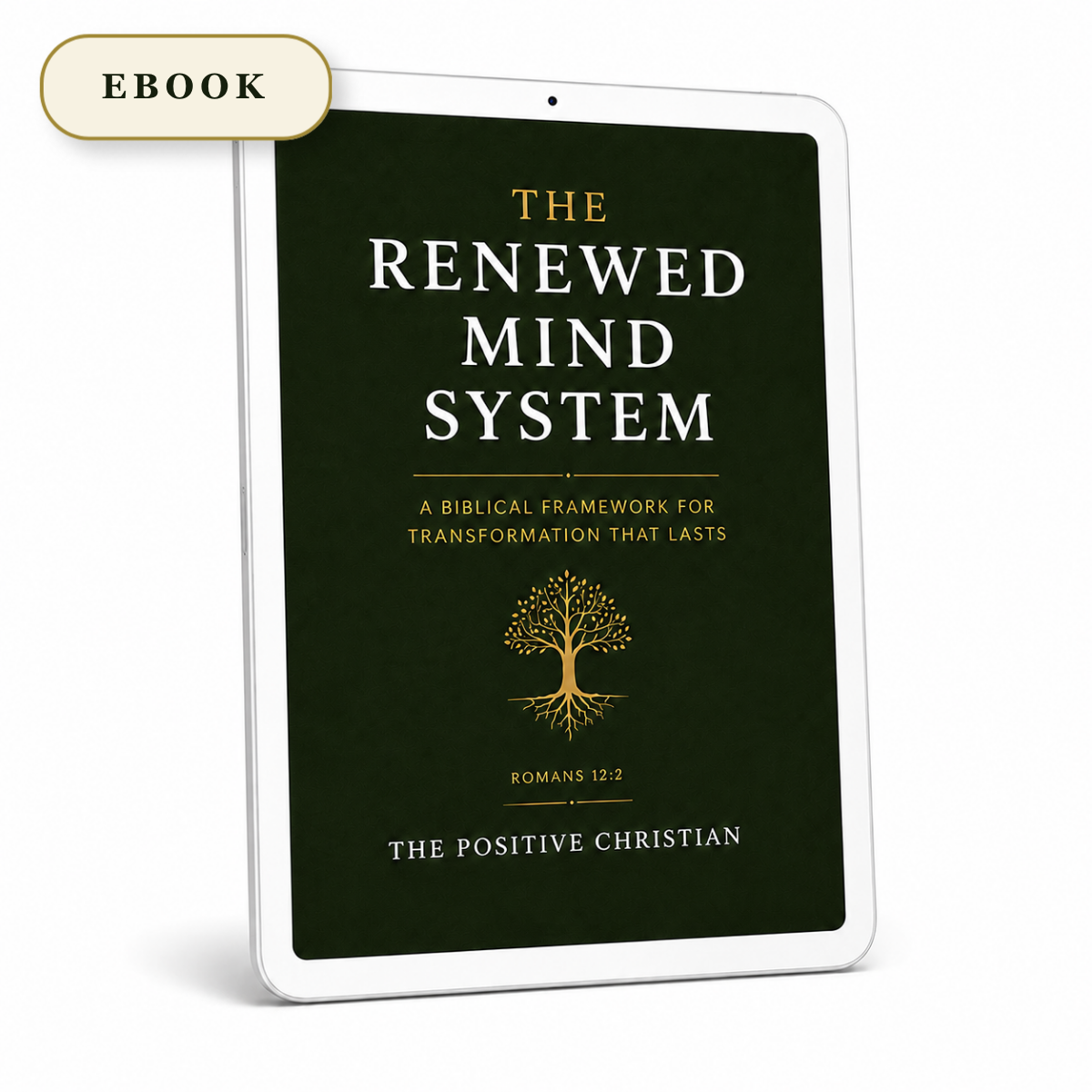
Ebook
Lifetime ebook access
$97
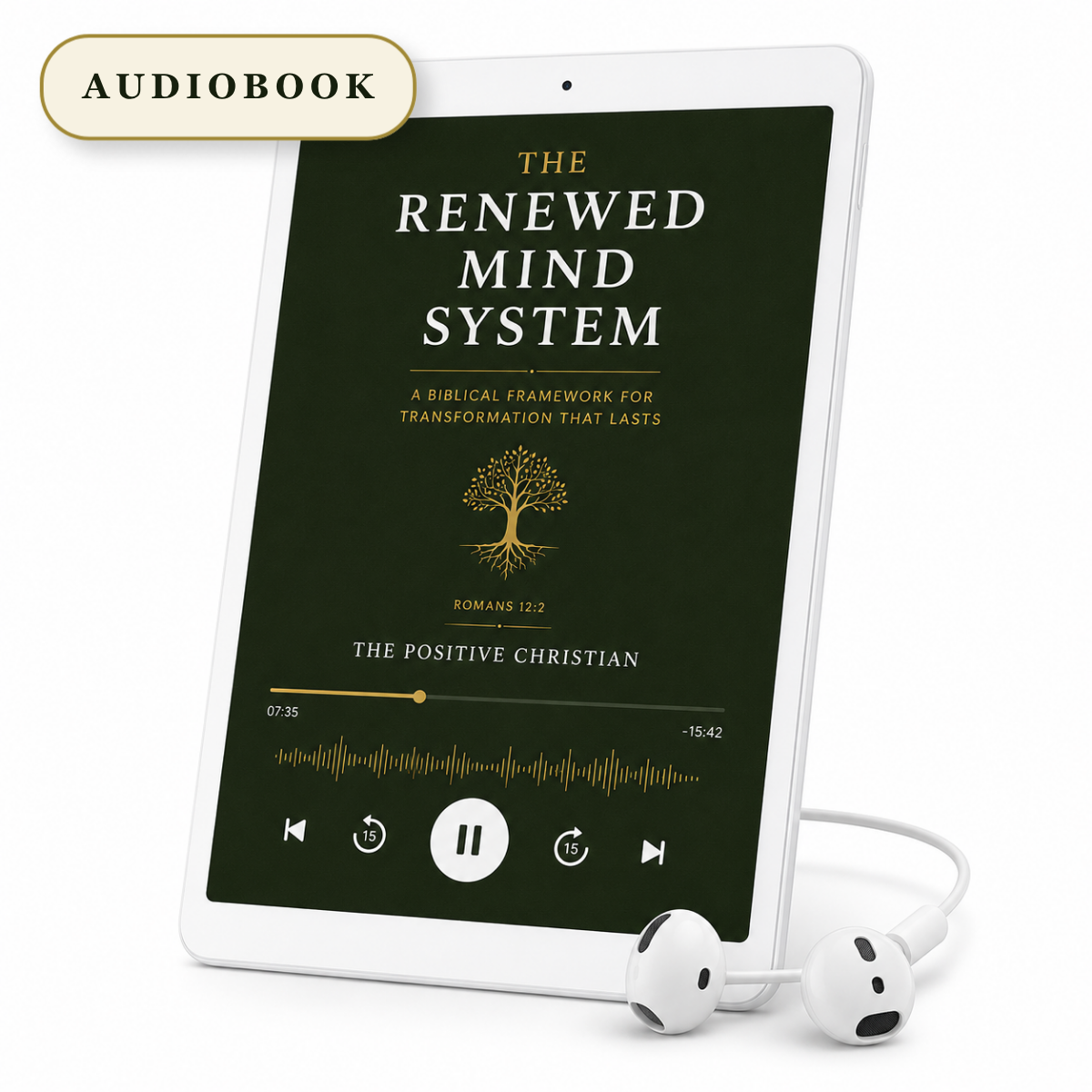
Audiobook
Audiobook + free ebook
$147

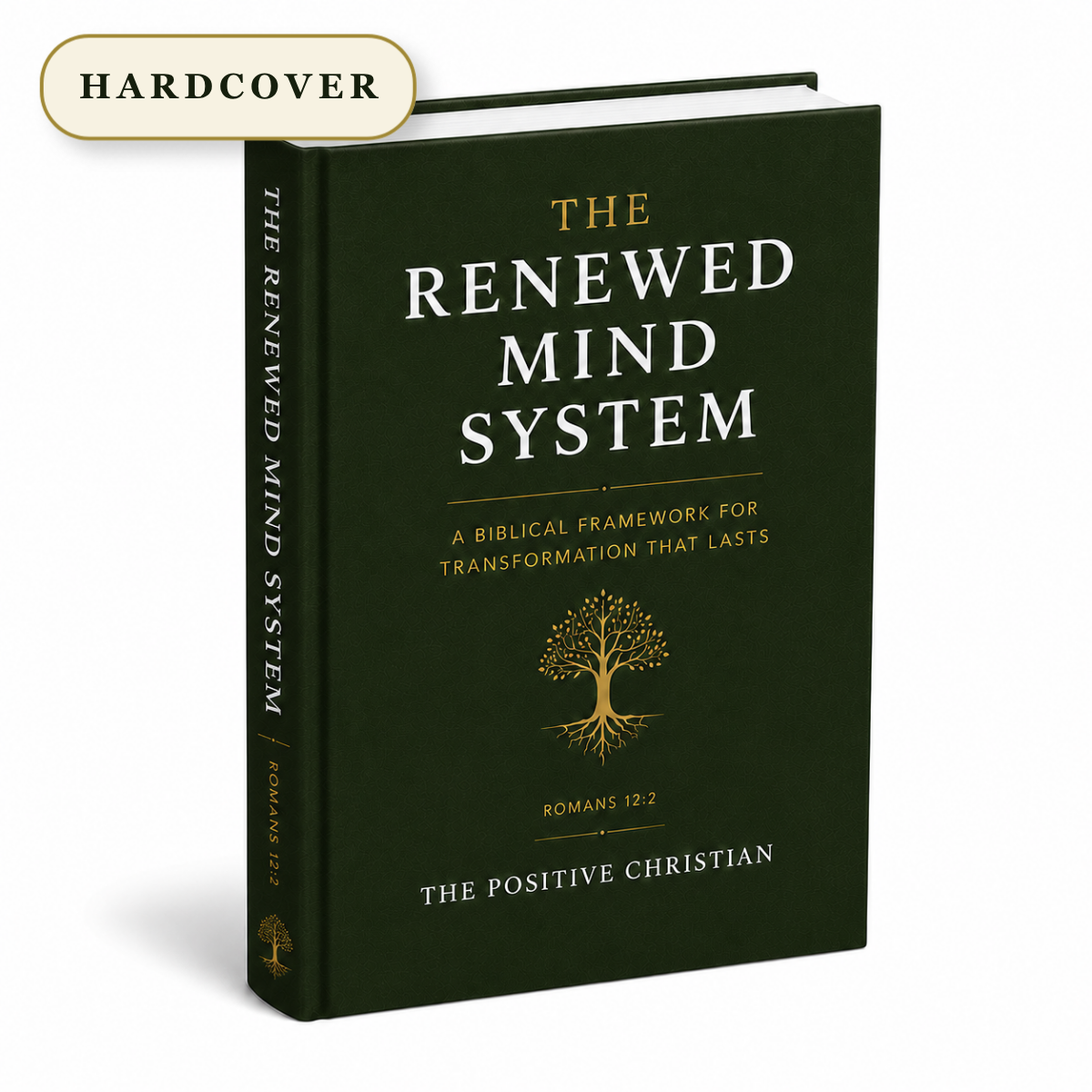
Hardcover
Hardcover + free ebook + audio
$197
Created by The Positive Christian

For almost a decade, The Positive Christian has encouraged believers through faith-based resources designed to keep God’s truth visible in everyday life.
The Renewed Mind System™ was created to go beyond encouragement by providing a practical, biblical path toward lasting transformation.

Trusted by
350,000+ Christians